Open enrollment has a fixed deadline and a variable amount of panic. The difference between a calm season and a chaotic one is rarely budget or head count. It is whether the work was laid out on a calendar before the window opened.
This is that calendar. Six weeks, one job per week, ending with a window that closes quietly instead of in a flood of last-minute tickets. If you are reading this with less than six weeks to go, compress the early weeks. The order still holds.
| Week | The job | The deliverable |
|---|---|---|
| Week one | Lock the source of truth | The final guide, one destination URL, and a three-sentence summary of what changed |
| Week two | Translate the guide into plain English | Plain-English decisions, a short glossary, and short videos on the hardest topics |
| Week three | Stand up the destination and test it | Everything live in one place, tested against last season’s top questions and a pilot group |
| Week four | Announce the window | A launch announcement from a person, and a brief for every manager |
| Week five | Run the window and watch what people ask | Segmented nudges, office hours twice a week, and a weekly “what people are asking” post |
| Week six | Close it out | Reminders for non-completers, a short deadline note, and answers on what happens next |
Before week one: three things in hand
The plan assumes three inputs. Chase them down before the clock starts:
- Final plan documents and rates from your broker or carriers. Not drafts. Every artifact you build will inherit whatever is wrong in them.
- A written list of what changed from last year: premiums, networks, new plans, dropped plans, new vendors. If you cannot list the changes, employees have no chance of spotting them.
- Your channels. Decide where announcements and reminders will actually run: email, Slack or Teams, text, managers, posters in the break room. Whatever reaches your team, including the ones who never open email.
Week one: lock the source of truth
Pick the one document that is authoritative, usually the benefits guide, and finalize it. Everything else you produce this season derives from it: the emails, the FAQ, the videos, the answers your team gives at office hours. When two artifacts disagree, employees notice, and trust in all of them drops.
Then decide the single destination where answers will live, one URL you can put on every email, poster, and paycheck stuffer. A benefits hub, an intranet page, even a well-kept doc. What matters is that there is exactly one door, because “where do I find anything” is itself a top-five question every season.
Close the week by writing the what-changed summary in three plain sentences. Not a table. Sentences a manager could read aloud in a stand-up.
Week two: translate it
The guide is a reference document. Nobody reads a reference document. This week you build the things people will actually use, all derived from the locked source:
- A plain-English version of the decisions. Not all sixty pages, just what am I choosing between, what does each option cost me per paycheck, and what changed since last year.
- A glossary for the terms people trip on: premium, deductible, copay, coinsurance, out-of-pocket maximum, HSA, FSA, network. Eight entries covers most of the confusion.
- Short videos for the two or three genuinely hard topics. How a deductible actually works, and how an HDHP pairs with an HSA, are the usual suspects. Sixty seconds each beats a webinar nobody attends.
The test for every piece: could a distracted person on a phone get the point in under a minute? If not, cut it in half and try again.
Week three: stand up the destination and test it
Put everything live at the single destination you chose in week one: the plain-English content, the glossary, the videos, the official documents for the people who want them.
If you run an assistant or chatbot on your benefits content, this is the week to load the approved documents and test it against your real inbox. Pull the ten questions your team answered most last season and ask them one by one. Where the answer is wrong or missing, the fix is almost always in the source document, which is exactly why you locked it first.
Then run a dry run with five to ten employees from different roles and ages. Watch where they stall. A pilot group finds the confusing plan comparison and the broken link while it is still cheap to fix, not in week five when four hundred people hit it at once.
Week four: announce it like you mean it
The launch announcement should come from a person, ideally a leader employees recognize, not from a system account. It needs to say exactly three things: when the window opens and closes, what changed this year, and the one place to go for everything else.
Arm managers the same day: the three sentences from week one, the URL, and permission to say “I don’t know, but here is where to look.” Managers get asked in hallways more than HR gets asked by ticket. Give them something accurate to say.
The launch email, the manager brief, and every reminder below are written out in the template pack, with the blanks marked, ready to edit.
One thing not to do: attach the full PDF guide to the announcement. The moment it leaves your outbox, it is a stale copy you cannot correct. Link the destination instead, and keep the destination current.
Week five: the window opens. Watch it.
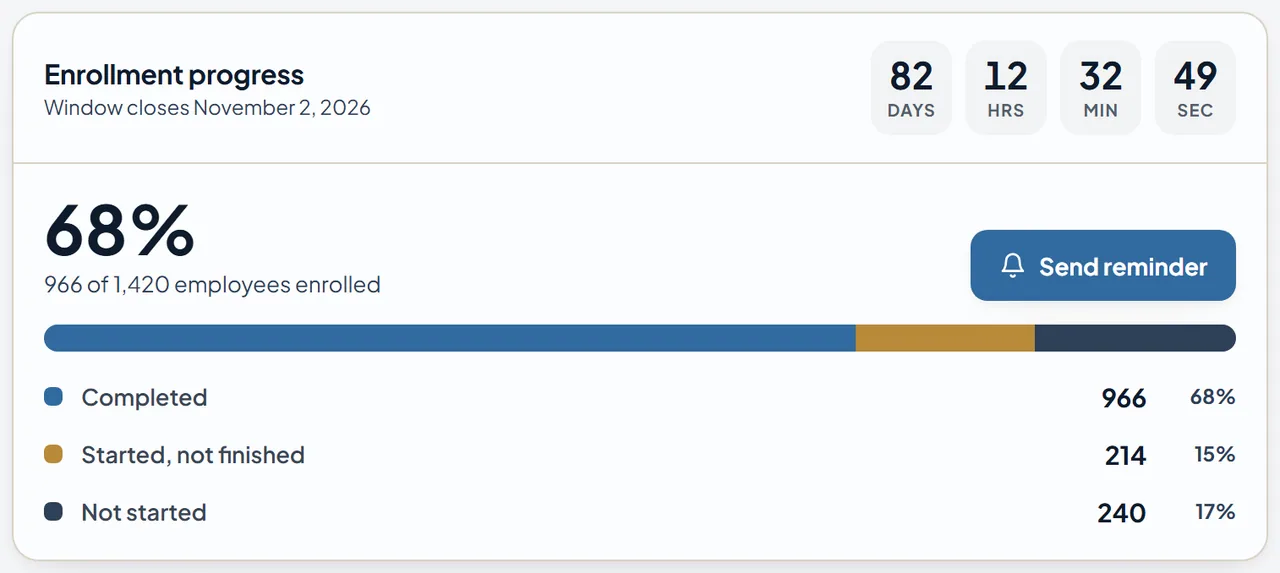
Open with a short note on day one, then resist the urge to blast everyone on a fixed schedule. Segment instead: people who have not started get a nudge mid-window, people who started and stalled get a different one, and people who finished get left alone. Nagging finishers is how the rest learn to ignore you.
Hold office hours twice a week for the questions that genuinely need a human: the employee with a mid-year surgery scheduled, the new parent weighing dependent coverage. These conversations are the actual human work of benefits, and they are what all the automation above is supposed to buy time for.
Most importantly, watch what people ask, daily. Whatever channel the questions arrive in, they are telling you in real time what your materials failed to explain. Publish the answers back to everyone with a short “what people are asking this week” post, and update the destination so the next person finds the answer without asking.
Week six: close it out
The final week is reminders for non-completers only, and the day-before-deadline note should be the shortest email of the season: the deadline is tomorrow, here is the door. Anyone still deciding does not need another paragraph of context. They need the date and the link.
After the window closes, confirm what happens next, because the questions do not stop when enrollment does. When do new cards arrive, when does the first different paycheck land, what changes on January 1. Two short answers now prevent a January ticket spike.
After: the 30-minute debrief
While it is fresh, pull the list of what people actually asked this season. The top ten questions are next year’s content plan, written for you by your own workforce. Note where people stalled, which channel actually moved completions, and which topic generated the most confusion.
Then keep the destination alive. New hires enroll year-round, qualifying life events do not wait for fall, and a benefits home that stays current turns next year’s week three from a build into a refresh.
A note on tooling
You can run every step of this playbook with email and a shared document, and plenty of lean teams do. What tooling changes is the cost of weeks one through three: turning a locked guide into plain-English content, videos, one destination, and tested answers is days of work with the right platform and weeks of work without it. Choose based on how much of that translation your team can absorb, not on feature lists.
Tobie turns the benefits guide you already have into a branded, year-round employee experience: plain-English content, explainer videos, and a source-grounded assistant. If your window is closer than you would like, talk with us.